Introduction
Search Engine Marketing (SEM) helps businesses reach potential customers when they actively search for products or services. Effective SEM requires planning, continuous optimization, and measurement. Businesses can improve performance by focusing on the right audience, keywords, advertisements, landing pages, and budgets.
1. Start with Clear Campaign Goals
Before launching an SEM campaign, decide what you want to achieve. Your goal may be traffic, leads, sales, calls, or awareness.
Set measurable targets such as:
- Cost per lead.
- Conversion rate.
- Return on ad spend.
- Qualified leads.
- Customer acquisition cost.
Clear goals make campaign evaluation easier and keep spending aligned with business priorities.
2. Choose High-Intent Keywords
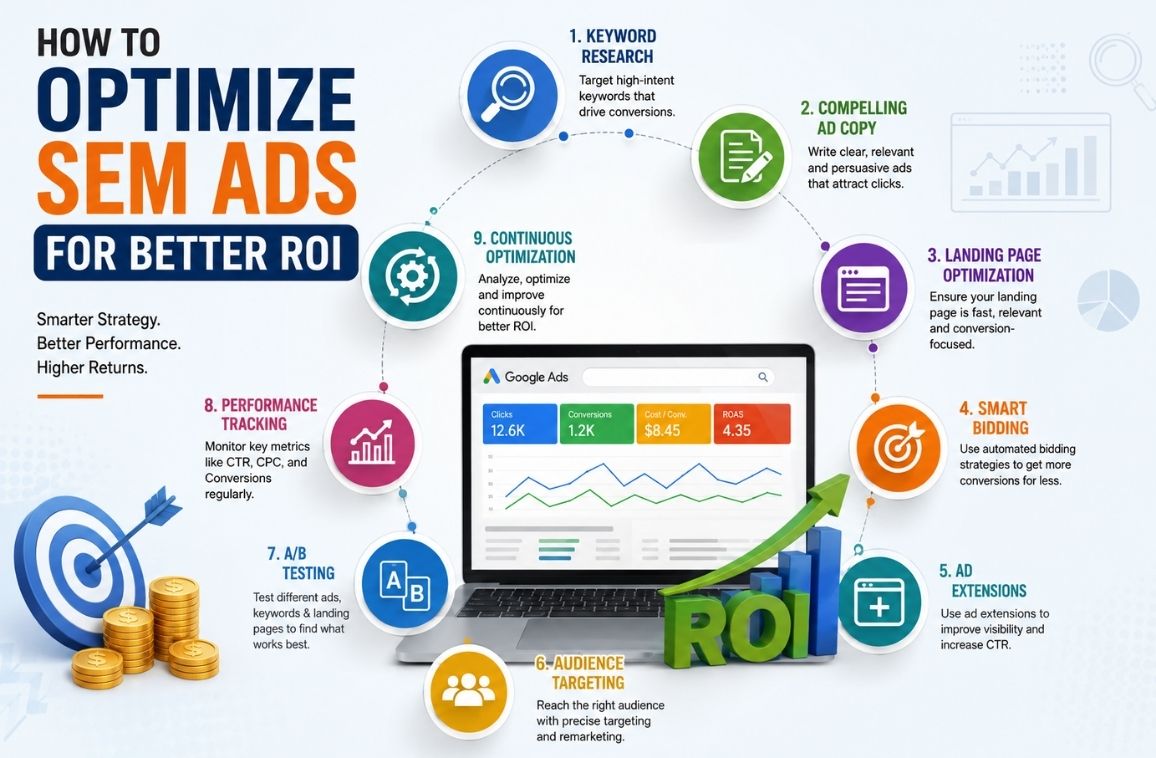
Keywords connect advertisements with customer searches. Instead of selecting only high-volume terms, focus on keywords showing strong purchase or enquiry intent.
Use:
- Specific product or service keywords.
- Long-tail keywords.
- Location-based keywords.
- Commercial search terms.
Remove keywords that attract visitors unlikely to convert. A focused keyword strategy can reduce wasted advertising spend and bring more qualified visitors.
3. Write Relevant and Compelling Ads
Your advertisement should quickly explain why users should choose your business. Include the main keyword naturally and highlight a clear benefit.
Effective ads can include:
- A strong headline.
- A specific benefit.
- A clear call to action.
- Trust-building information.
- Relevant offers.
Create multiple ad variations and compare their performance. Testing identifies messages that generate better conversions and reveals which benefits appeal to potential customers.
4. Improve Your Landing Pages
An excellent advertisement can still produce poor ROI if the landing page is confusing or slow. Make sure it matches the promise made in the advertisement.
Focus on:
- Fast loading speed.
- Mobile-friendly design.
- Simple navigation.
- Clear headlines.
- Strong calls to action.
- Short, relevant forms.
Make the desired action easy to increase conversions and reduce steps for visitors.
5. Use Location and Audience Targeting
Targeting settings help businesses spend budgets efficiently. For local businesses, location targeting ensures advertisements reach people in relevant areas.
For example, a digital marketing company in Hyderabad can focus SEM campaigns on users searching for marketing solutions in the city.

Audience data can identify valuable customer groups. Adjust bids and messaging based on device, location, time, and audience performance.
6. Manage Your Budget Carefully
Budget optimization is essential for better ROI. Do not automatically spend more on every campaign receiving clicks. Review conversion data before increasing budgets.
Allocate more budget to campaigns, keywords, and audiences that consistently generate profitable results. Reduce spending on areas with high costs and low conversions.
7. Monitor Conversion Tracking
Clicks and impressions are useful, but they do not tell the complete story. Set up conversion tracking to understand what users do after clicking an advertisement.
Track actions such as:
- Form submissions.
- Purchases.
- Calls.
- Downloads.
- Appointment requests.
Tracking enables evidence-based decisions.
8. Use Negative Keywords
Negative keywords prevent advertisements from appearing for irrelevant searches. This reduces wasted clicks and keeps the campaign focused on search traffic.
Review search terms regularly and identify unrelated queries. Adding them as negative keywords helps protect your budget and keeps campaigns focused on relevant prospects.
9. Test and Optimize Continuously
SEM optimization is not a one-time task. Search behavior, competition, costs, and customer expectations can change frequently.
A professional digital marketing consultant in Hyderabad can review campaign data, test strategies, and identify opportunities for improvement. Regular testing can steadily improve performance and help marketers respond to changing conditions.
10. Measure ROI, Not Just Traffic
The goal of SEM is business growth. Compare advertising costs with the revenue or value generated from conversions.
Businesses working with an online marketing agency in Hyderabad can use performance reports to understand which campaigns deliver meaningful results. Focus on profitable conversions, customer quality, and long-term value rather than vanity metrics.
Conclusion
Optimizing SEM ads requires strategy, testing, tracking, and continuous improvement. By choosing high-intent keywords, creating relevant advertisements, improving landing pages, targeting the right audiences, controlling budgets, and measuring conversions, businesses can reduce wasted spending and achieve stronger returns.
SEM works best when every part of the customer journey supports the same objective. Regular analysis helps build efficient, measurable, profitable campaigns.